
Know when roadside sensing may be nearby.
BanditKin Sentinel is a compact USB-C accessory — in development and in-house testing — designed to detect supported electronic activity and, when a validated sensor configuration supports it, estimate a candidate source area, with visible uncertainty instead of false certainty.
Wired USB-C · Receive-only toward observed equipment · No jamming, injection, or impersonation
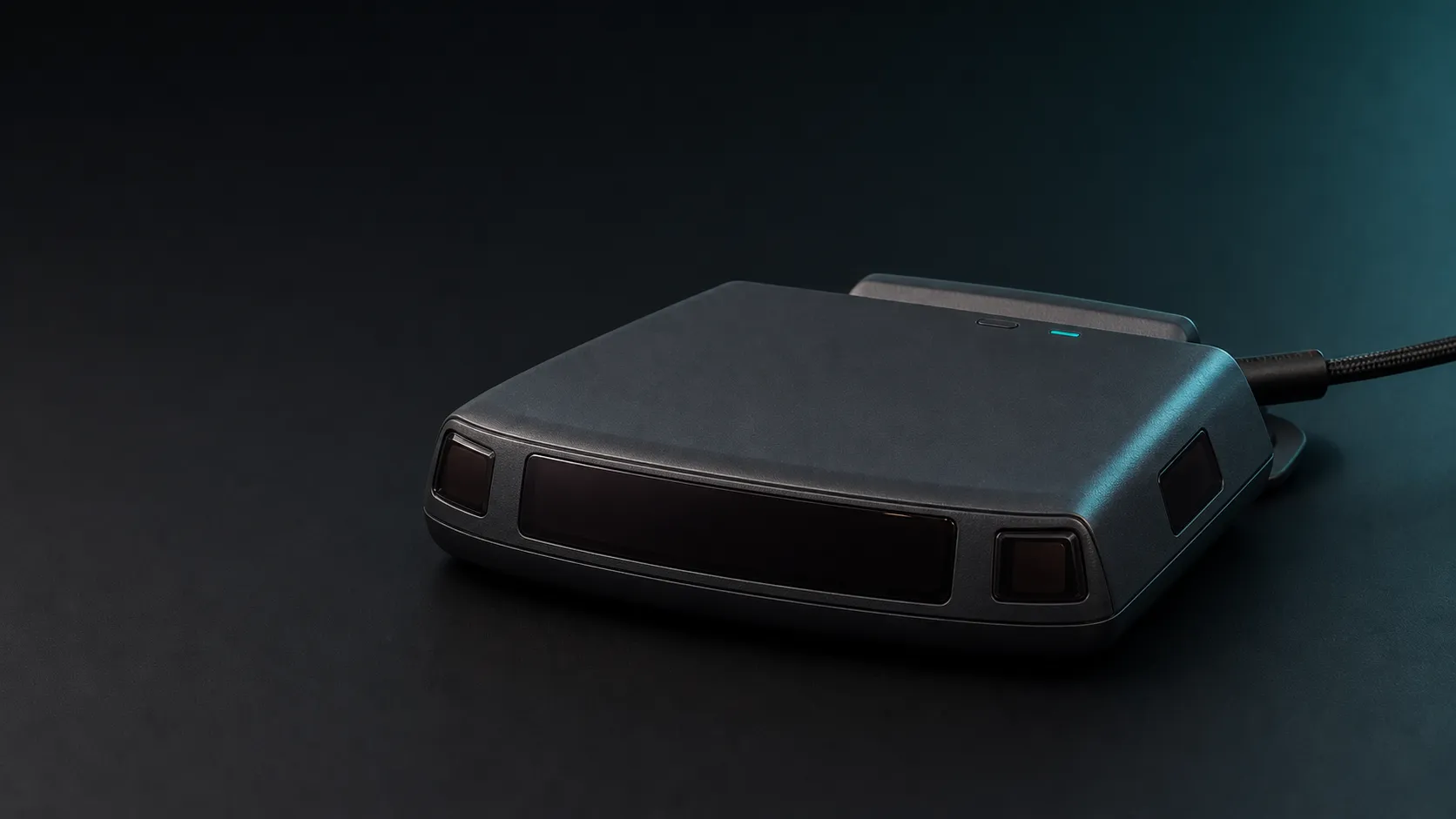
In development and in-house testing. Final capabilities, compatibility, pricing, and availability will be published after repeatable testing and required certification.
Receive-only by design
The consumer requirement is to observe roadside equipment, never to contact, jam, or interfere with it.
Wired USB-C
Power and event data travel over a wired USB-C link to a nearby BanditKin device — no separate battery or radio uplink in the pictured design.
Local processing planned
The design target keeps observation and event processing on your device. What can be uploaded, and when, is a published user choice.
No silent sharing
A design requirement: nothing is added to any community map without an explicit action you take.
Unmarked shouldn't have to mean unknowable.
Roadside monitoring equipment isn't always obvious from a passing vehicle. Some systems produce observable radio, radar, or optical activity. Others may be fully wired, passive, shielded, or silent. Sentinel is being designed to recognize supported activity, measure where it appears to originate, and preserve the observation as a candidate — not automatically declare what the device is. A useful privacy tool should help you investigate without pretending every signal is proof.
Detect supported activity
Recognize the radio, radar, or optical activity a sensor configuration is built to observe.
Estimate direction when supported
Direction-capable sensor heads measure bearing, not just that energy exists somewhere nearby.
Build location confidence
Combine observations from different positions into a candidate source area over time.
Keep uncertain results labeled
Unknown activity stays unknown until stronger evidence supports a stronger conclusion.
From a signal to a candidate location
1. Plug it in
The accessory connects to a supported BanditKin device over USB-C, with its sensing face positioned toward the road.
2. Drive normally
Receive-only sensors observe supported activity while the connected device supplies time, position, movement, and heading when localization is enabled.
3. Compare multiple passes
Localization software combines direction, timing, and signal behavior from different positions to distinguish stationary roadside sources from passing vehicles, reflections, and unrelated transmitters.
4. Review the evidence
See a signal class, candidate source area, confidence level, and observation count — reviewed only when safely parked. You choose whether to save, revisit, dismiss, or submit it.
Design target: estimate evidence-bearing source areas without claiming an exact device location or vendor identity.
Evidence that says what it knows — and what it doesn't.
The unit observes supported live activity nearby. This is awareness, not a confirmed map location.
One or more observations support a candidate source corridor or area. The uncertainty stays visible.
Repeated observations support a stationary candidate area, shown with its observation count, geometry, and last-observed date — without presenting a vendor identity as confirmed.
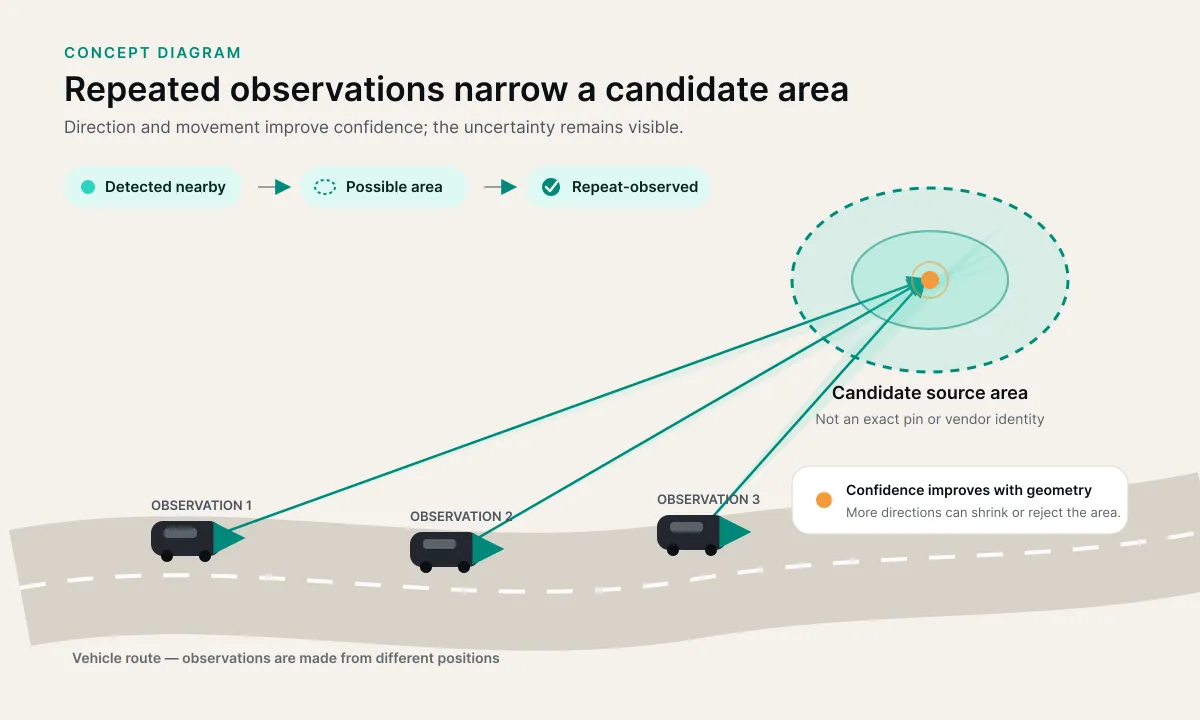
Design rule: a low-confidence observation cannot silently become a confirmed vendor identity.
Built for useful evidence, not alarm fatigue.
More than a strength meter
Direction-capable sensor heads measure timing, direction, and signal behavior — not merely that energy exists somewhere nearby.
Movement-assisted localization
Observations along the vehicle's path intersect into a candidate source area. More passes and different approach directions can improve confidence.
False-alert controls
Direction, movement, repetition, source behavior, and history help separate roadside infrastructure from vehicle radar, nearby radios, automatic doors, and reflections.
Confidence without overstatement
Results stay labeled by evidence state and confidence. Unknown activity stays unknown until stronger evidence supports a stronger conclusion.
Wired by design
USB-C carries power and event data to a nearby BanditKin device. The sensor does not need to contact observed equipment.
Designed to evolve
A common processor and modular receive-only sensing sections are being evaluated. Upgradeability is a development target, not a durability or compatibility promise.
A receiver, not a dashcam.
The road-facing center panel provides the RF aperture; the four flat optical windows imply directional pulse sensing without being cameras. There is no screen, camera, or microphone in the pictured enclosure.
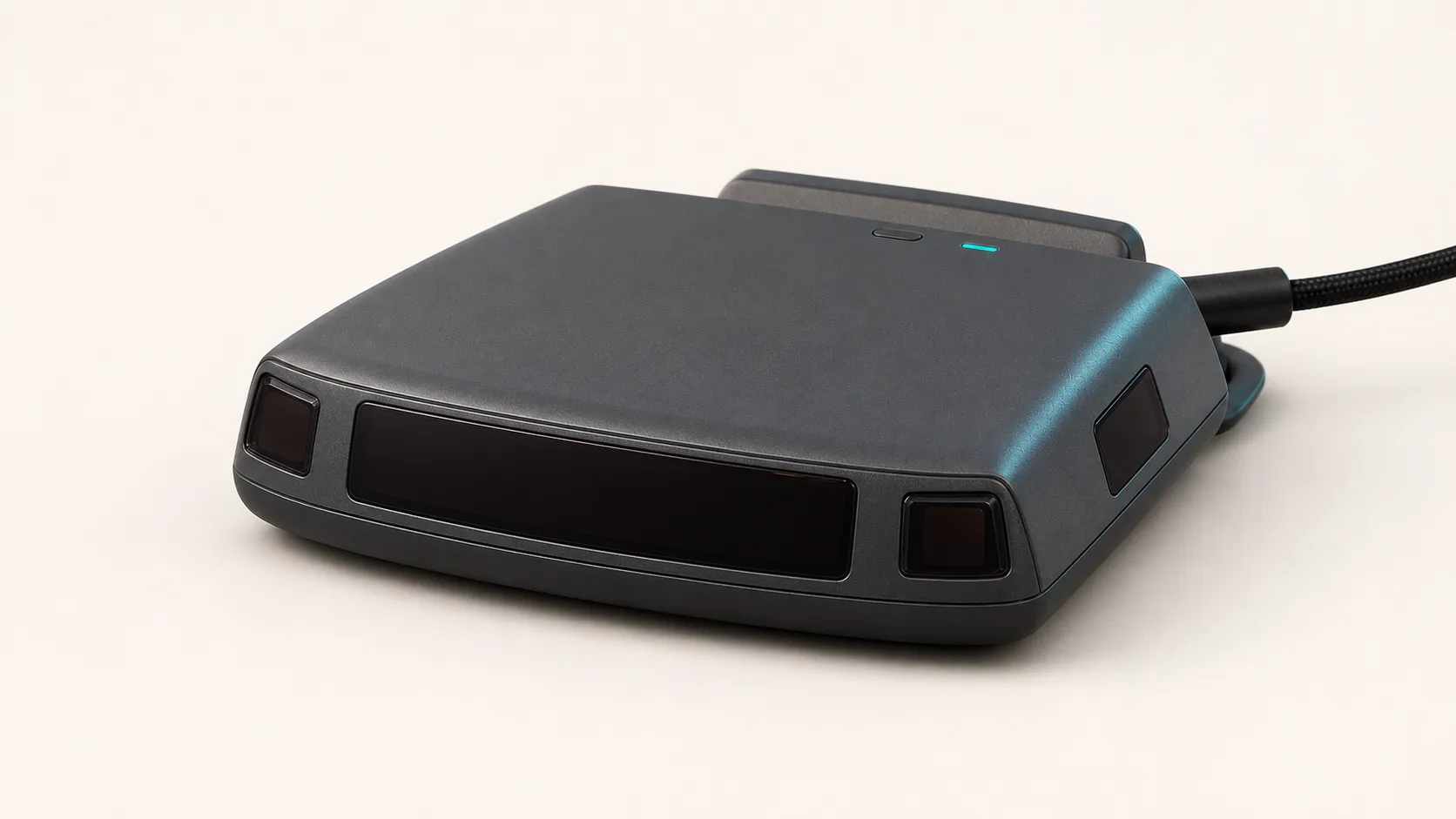
Product render — installed sensor coverage varies by model.
Intended setup: mount, connect, calibrate.
A validated mount places Sentinel near the mirror or another approved location that doesn't block your view or vehicle sensors. The marked sensing face aims toward the road; the USB-C cable routes to a documented host/power connection; a guided calibration checks orientation. It's designed to work without driver interaction — review observations only when safely parked.
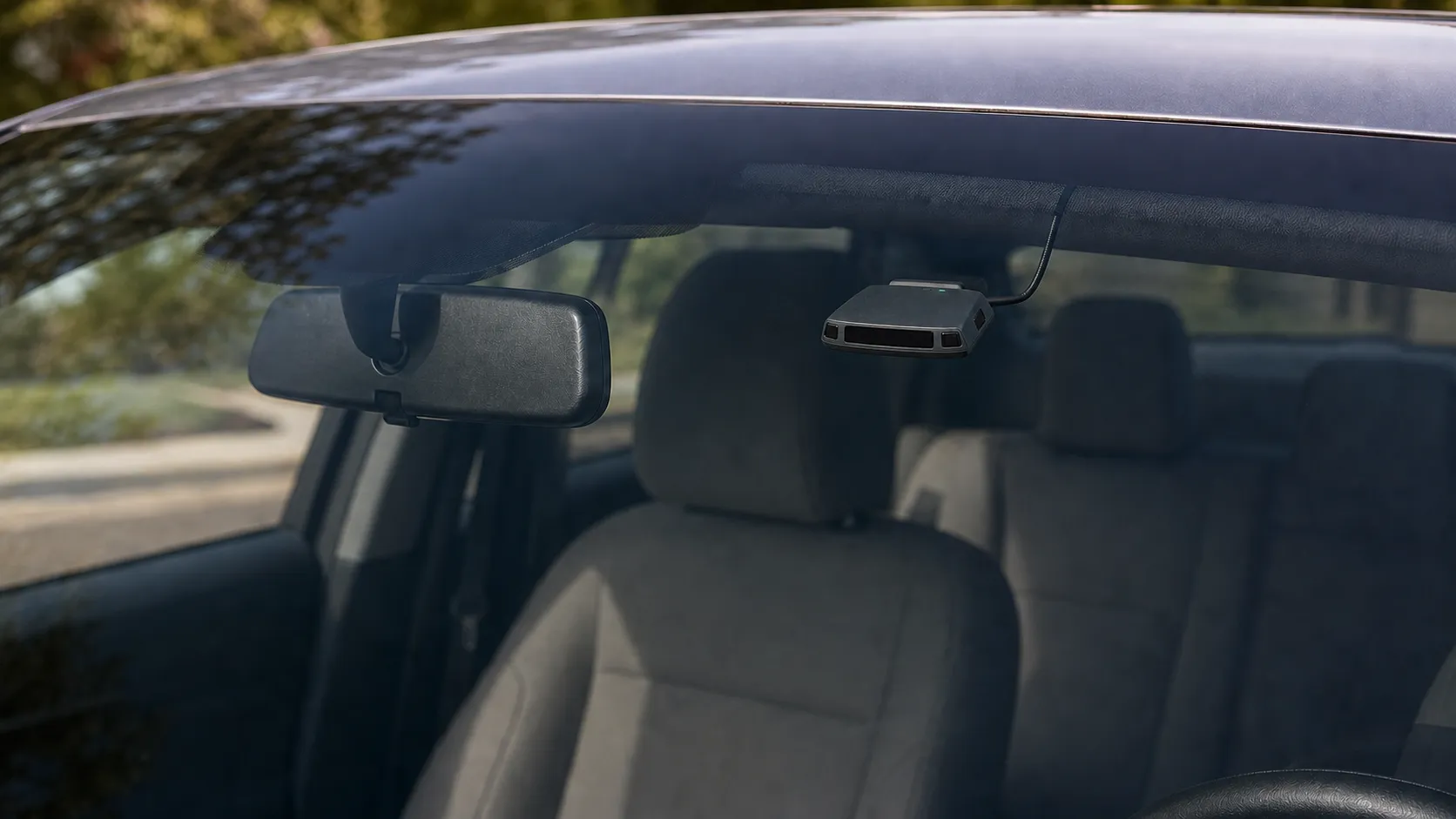
Placement shown for illustration only. Final mount location, cable route, USB host support, and vehicle compatibility remain under validation.
Want to follow the build?
Join development updates and hear when verified test results or future testing opportunities are published.
Designed around observable activity — not universal promises.
Sensor configurations under evaluation include:
Radio activity
Selected sub-GHz, 2.4 GHz, and 5 GHz activity associated with supported devices. Exact bands and classification support will be listed by production model.
Millimeter-wave activity
Optional receive-only sensing for supported 60 GHz and 76–81 GHz activity, subject to field validation, cost, regulatory testing, and production feasibility.
Optical pulses
Optional sensing of supported near-infrared pulse activity. Observing a pulse does not by itself identify the product that produced it.
Designed to characterize roadside activity — not identify people.
The consumer design is limited to observation and evidence reporting over a wired connection. The production requirements prohibit target-directed jamming, injection, or impersonation hardware.
No camera or plate recognition
No license-plate or facial recognition, and no camera in the pictured enclosure.
No microphone
The pictured enclosure has no microphone and does not record intelligible audio.
No jamming or interference
No jamming, packet injection, or impersonation of third-party equipment.
Identifiers out of scope
Raw persistent personal-device identifiers are out of scope for the consumer data model.
No silent submission
No community submission happens without an explicit action you take.
Signed, verifiable firmware
Signed firmware, rollback protection, and a consumer-specific bill of materials are production requirements.
Before orders open, BanditKin will publish every event field, what stays local, what can be uploaded, retention, deletion, public-location precision, account/IP handling, and whether separate reports can be linked into a route.
Observation stays local unless you choose otherwise.
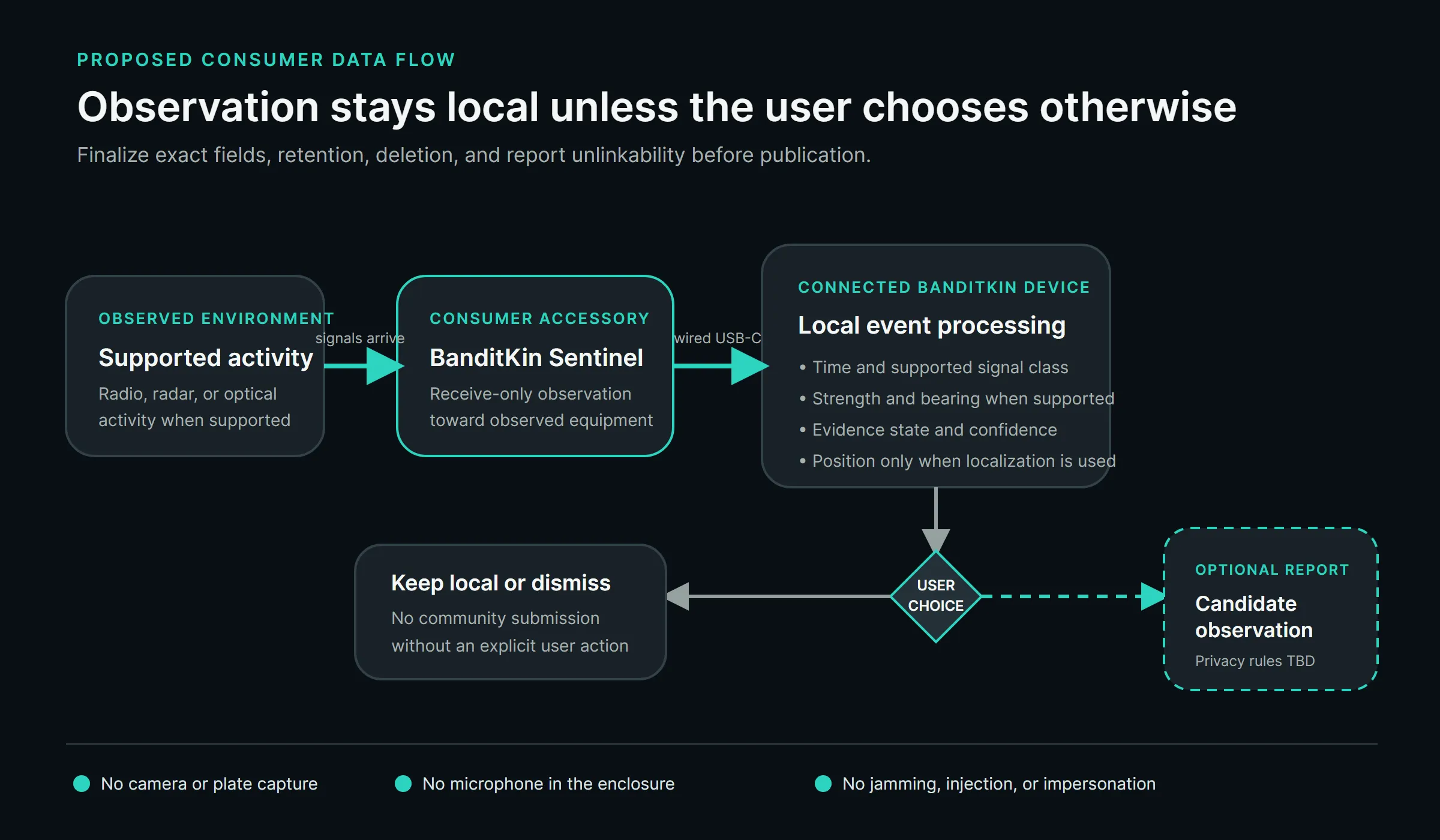
Proposed data flow. Exact fields, retention, deletion, and report unlinkability remain to be finalized before publication.
An architecture limited to observation.
The enclosure illustrates a forward RF-transparent panel, four directional optical windows, a common USB processor, and a removable windshield cradle. The bill of materials is intended to omit target-directed transmit hardware and must be independently verified before that becomes a product claim.
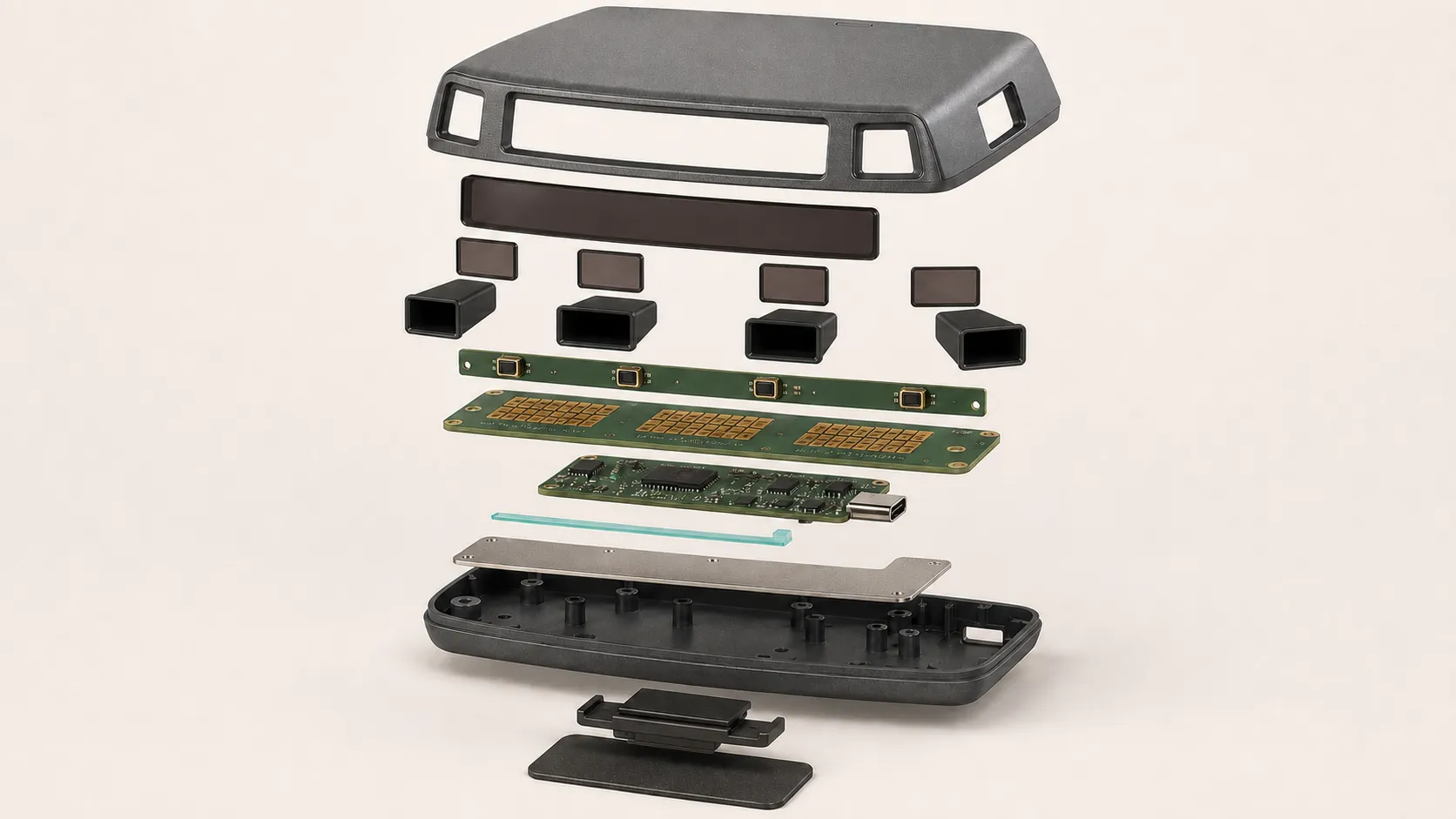
Advanced modular receive-only architecture — not the under-$40 Base configuration. Component selection, PCB layout, sensor coverage, thermal design, and production configuration remain subject to validation.
Consumer model targets
Product type
External roadside-awareness sensor, receive-only toward observed equipment.
Host connection
Wired USB-C, 5 V USB power. Location and heading supplied by the connected BanditKin device.
Event output
Timestamp, signal class, strength, estimated bearing when supported, evidence state, and confidence — compact metadata, not continuous raw content.
User controls
Save, dismiss, revisit, or optionally submit a candidate report. Signed firmware with downgrade protection planned.
No target-directed transmit
Intended to be absent from the production bill of materials; independent verification required.
Enclosure
Approximately 118 × 62 × 26 mm before final engineering validation. Bands, modalities, and environmental rating to be confirmed by production model.
These are development targets, not final certified specifications. Performance depends on observed equipment, orientation, obstructions, reflections, traffic, sensor configuration, and location/heading quality.
Target base price: under $40
The target is an affordable receive-only base detector. More advanced sensing heads will be offered only when their performance, production cost, and regulatory path are validated.
BanditKin Sentinel Base — target under $40
Wired USB-C connection · receive-only configuration · supported radio-activity detection with exact bands listed after validation · confidence-rated BanditKin events · signed firmware updates planned.
Advanced receive-only sensing — to be announced
Optional millimeter-wave and optical sensor heads remain under evaluation. Price and availability will be announced after validation.
No payment today. Preorders open only after the final configuration, verified capabilities, price, and estimated delivery window are published.
Be first to know when Sentinel is ready.
Join the list for development updates and an early heads-up the moment BanditKin Sentinel is ready. No payment today, and no open field-test program is implied.
Straight answers about what it can and can't do.
Why isn't the BanditKin app alone enough?
A map can alert to locations it already knows. Compatible hardware may notice supported activity at a new or unmarked location and collect the directional evidence needed to improve a candidate area.
Does Sentinel detect every ALPR camera or roadside monitoring system?
No. Sentinel is limited to supported, detectable activity. A passive camera, fully wired sensor, buried system, shielded device, or unfamiliar technology may emit nothing it can identify. No consumer detector can honestly guarantee universal coverage.
Can it identify Flock, SignalTrace, or another vendor from a signal?
Not from a generic signal alone. The interface reports observable activity and a candidate source area. Vendor attribution requires separate corroboration such as verified installation records, visual evidence, or a validated vendor-specific signature.
Does it pinpoint an exact location?
It estimates a candidate source area by combining observations from different positions. Accuracy depends on sensor type, signal quality, reflections, location and heading quality, traffic, and observation count.
Why not publish a detection range now?
There is no single honest range. Signal type, antenna orientation, obstructions, windshield construction, reflections, and the surrounding environment change performance dramatically. BanditKin will publish repeatable field-test results for each production configuration.
Could my car or another vehicle cause an alert?
Yes. Modern vehicles contain radio and radar systems. Sentinel is being designed to use direction, movement, repetition, source behavior, and your feedback to reduce false alerts, but no classifier is perfect.
Does detection stop data collection?
No. Sentinel is for awareness and documentation. It is not intended to jam, interfere with, alter, or disable third-party equipment.
Does it record conversations, plates, or faces?
The pictured enclosure has no camera or microphone. Sentinel does not perform license-plate or facial recognition.
Does it track nearby phones or vehicles?
The production requirement is to exclude raw persistent personal-device identifiers from the consumer event model. Exact event fields and any transformation of observed identifiers remain unpublished and will be independently reviewed before launch.
Is information automatically added to a public map?
No. You would have to choose to submit a candidate observation. Exact uploaded fields, retention, public-location precision, deletion, and route unlinkability will be published before this feature is enabled.
Does it work without internet service?
The target is local sensing and event processing. Downloading map data, sharing observations, or receiving updates may require connectivity. Final offline behavior will be published before launch.
Can I legally use and mount it where I drive?
Rules vary by jurisdiction, vehicle type, mounting location, and product classification. Commercial-vehicle and radar-detector-related restrictions may apply in some places. BanditKin will complete specialist regulatory and legal review before sale; follow applicable local law and vehicle instructions.
Help make hidden infrastructure easier to document.
Join BanditKin Sentinel development updates and indicate whether you may be interested in future testing. No production hardware or open field-test program is implied.
The goal: measurable evidence, transparent uncertainty, no guaranteed attribution, and a design built around your privacy.
BanditKin Sentinel is in development and in-house testing and is not yet offered for sale. Images are renders. Features, sensor coverage, compatibility, dimensions, pricing, and delivery timing may change during validation and certification. Detection does not establish ownership, identity, legality, or purpose of observed equipment. BanditKin is not affiliated with roadside camera, ALPR, radar, telecommunications, or sensor-system manufacturers. Third-party names and trademarks belong to their respective owners.